

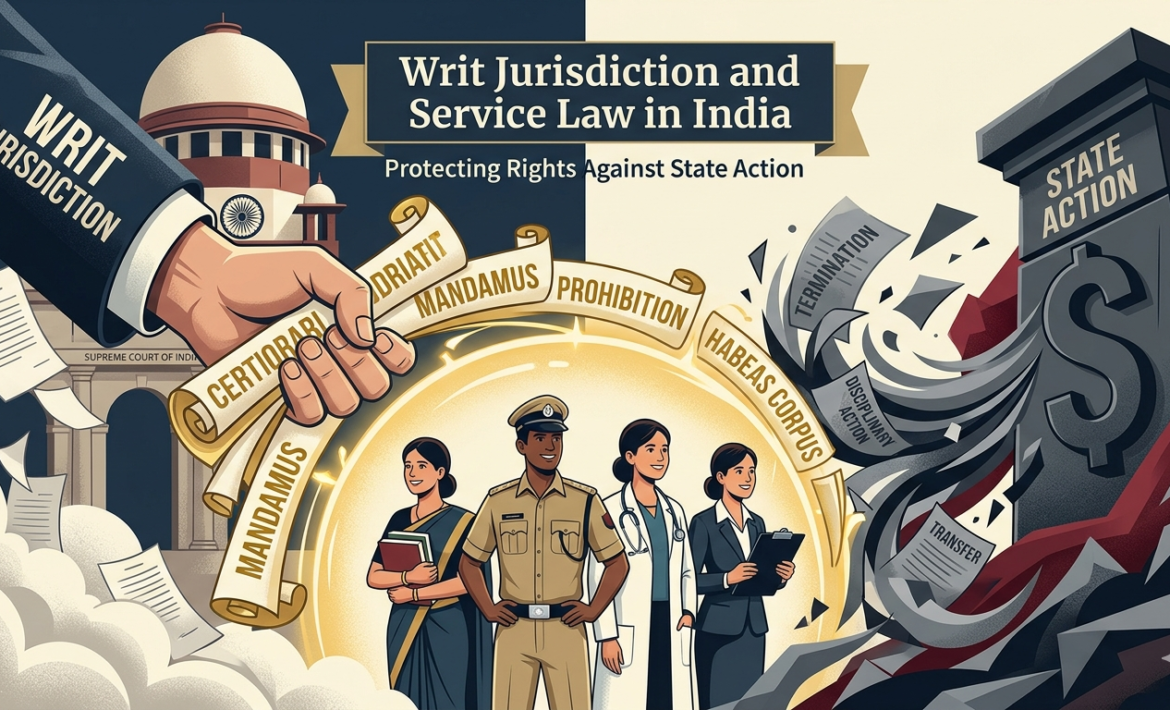

Introduction: The Constitutional Safeguard
Writ jurisdiction is one of the most powerful tools available under the Constitution of India for the protection of individual rights. It ensures that the actions of the State and its authorities remain within the bounds of law and are subject to judicial scrutiny. Closely linked to this is the field of service law, which deals with disputes involving government employees and administrative authorities, making it a vital area of legal practice.
Understanding Writ Jurisdiction
Writ jurisdiction empowers the High Courts and the Supreme Court to issue directions and orders for the enforcement of rights. Unlike ordinary legal remedies, writ petitions provide a direct and effective mechanism for addressing violations of fundamental and legal rights. This jurisdiction plays a crucial role in maintaining the rule of law and ensuring accountability in governance.
Scope of Service Law
Service law governs the relationship between government employees and the State, covering matters such as recruitment, promotions, disciplinary actions, and retirement benefits. Given the scale of public employment in India, disputes in this area are both common and complex. These cases often involve detailed examination of rules, regulations, and principles of fairness.
Grounds for Filing Writ Petitions
Writ petitions are typically filed in cases involving arbitrary administrative action, violation of fundamental rights, or failure of authorities to act within their jurisdiction. Courts examine whether due process has been followed and whether the principles of natural justice have been upheld. This ensures that individuals are treated fairly and that decisions are made in accordance with the law.
Importance of Legal Strategy
The success of a writ petition largely depends on the strength of its legal foundation and the manner in which it is presented. Precise drafting, clear articulation of facts, and strong supporting documentation are essential. Since writ remedies are discretionary, a well-planned legal strategy is crucial in persuading the court to grant relief.
Role of Courts and Tribunals
Service-related disputes are often adjudicated by specialised tribunals, with their decisions subject to review by higher courts. This multi-layered system requires a thorough understanding of both procedural and substantive law. Effective representation at each stage is essential to ensure a favourable outcome.
Challenges in Writ and Service Law Matters
Litigation in this area involves strict procedural requirements and a limited scope of judicial review. Courts generally refrain from interfering in policy matters unless there is a clear violation of law. This makes it important for litigants to present well-prepared cases supported by strong evidence.
Conclusion: Upholding Rights Through Legal Remedies
Writ jurisdiction and service law together form a critical framework for protecting individuals against arbitrary state action. They ensure that power is exercised responsibly and that justice is accessible to all. With the right legal guidance and timely action, individuals can effectively assert their rights and achieve fair outcomes in even the most complex situations.